Industrial Intelligence,
Spatialized.
Bridging the Physical & Digital Divide
Industrial Digital Twins are no longer just static 3D models. They are live, interconnected ecosystems that empower enterprises to visualize massive telemetry streams over highly accurate spatial models, instantly accessible via standard web browsers.
What is an Industrial Digital Twin?
A digital twin is a highly accurate virtual representation of a physical object, system, or process. In industrial contexts like manufacturing plants, refineries, or supply chain hubs, it serves as a central interface for Internet of Things (IoT) sensors, SCADA systems, and historical data.
By visualizing telemetry over a spatial model, operators gain immediate contextual awareness. Instead of reading spreadsheets to find a failing pump, they can see the exact pipeline pulsing red in their virtual environment.
The ROI of Egocentric Skill Transfer
Beyond monitoring, Digital Twins revolutionize enterprise training. Traditional manuals force cognitive translation—reading 2D text and attempting to apply it to a 3D machine.
Using GRAHAs VR platforms like Zeal X, we bypass this friction. Immersing the workforce directly into the virtual replica yields profound results. Organizations consistently achieve 4 times faster and 4 times focused training compared to conventional classroom methodologies.
Powered by the STEP Framework
Technology is only as effective as the pedagogy behind it. In developing our immersive content, we deploy our proprietary, internationally recognized STEP Framework (Story, Emotion & Place).
Rooted in deep cognitive psychology, narrative learning, and neuroscience, this framework ensures that data isn't just displayed—it's contextualized. By anchoring technical telemetry within spatial memory, we dramatically increase human retention and operational confidence.
Zero-Friction WebXR Architecture
The biggest bottleneck to XR adoption has historically been hardware and app distribution. Our SPACES Enterprise Lab infrastructure completely eliminates this barrier.
By leveraging advanced WebGL and WebXR APIs on a serverless Next.js architecture, we render massive, high-fidelity industrial models natively in the mobile browser at 60FPS. Users simply click a link or scan a QR code to project complex Digital Twins directly into their physical space via ARCore/ARKit.
Experience the SPACES Engine Live
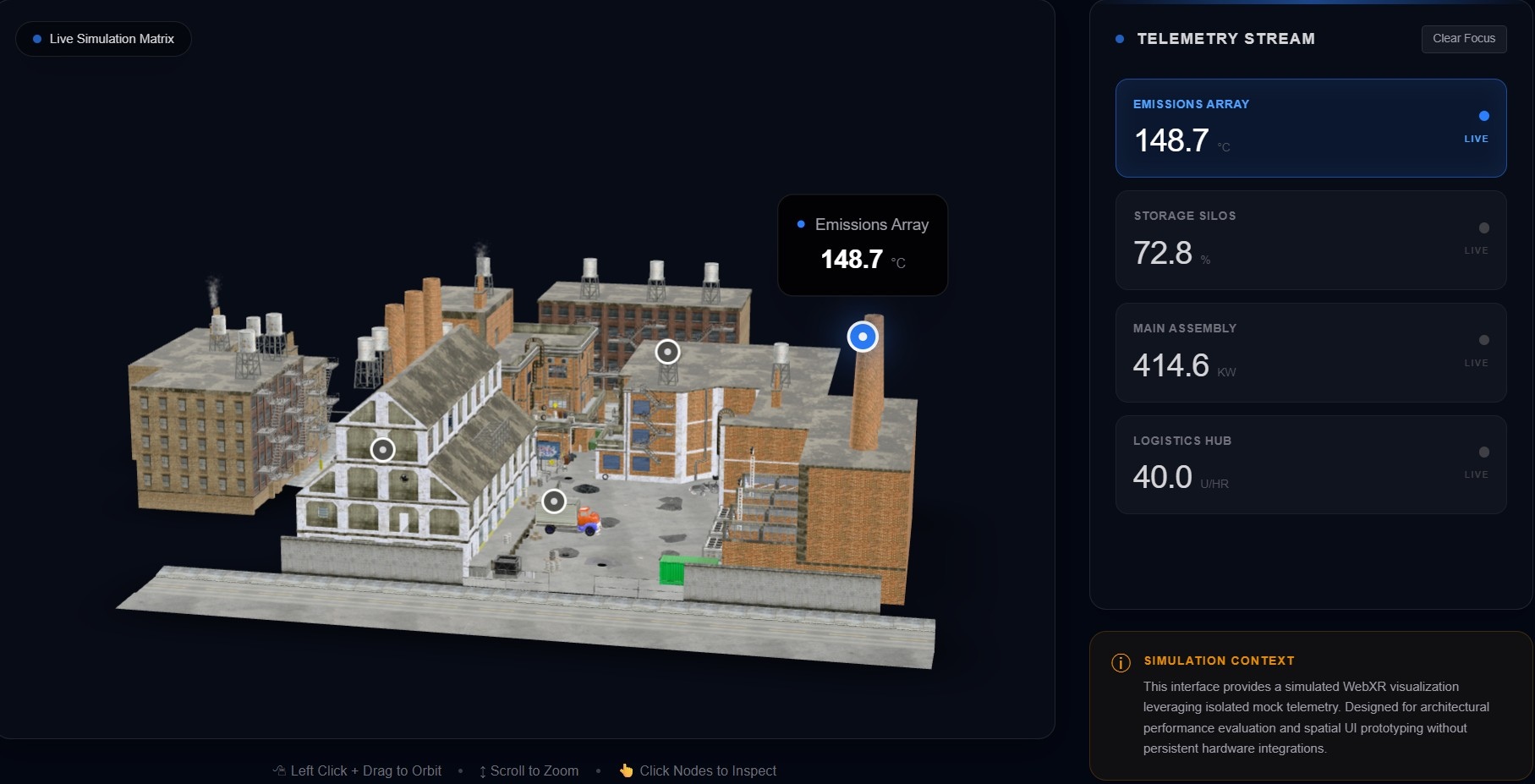
Interact with the nodes below to inspect the live WebXR telemetry stream.
Initializing WebXR Engine...
🖱 Left Click + Drag to Orbit↕ Scroll to Zoom👆 Click Nodes to Inspect
Telemetry Stream
Simulation Context
This interface provides a simulated WebXR visualization leveraging isolated mock telemetry. Designed for architectural performance evaluation and spatial UI prototyping without persistent hardware integrations.
Frequently Asked Questions
Common questions about our spatial intelligence framework.
What is the GRAHAs VR Digital Twin Simulator?▼
It is an enterprise WebXR platform demonstration that empowers brands and industrial enterprises to deploy zero-friction 3D and Augmented Reality (AR) experiences directly to their audience's smartphones without requiring native app downloads. It leverages our hybrid full-stack spatial computing architecture.
How does spatial computing enhance industrial training and operations?▼
Integrating digital twins into your operational pipeline allows for egocentric skill transfer and rapid onboarding. Our XR enterprise solutions, such as Zeal X, provide 4 times faster and 4 times focused training compared to traditional classroom or manual-based methods by immersing users in high-fidelity industrial models.
What technology powers this browser-based AR/VR experience?▼
The platform seamlessly merges enterprise-grade web infrastructure with advanced rendering tech. The Application Layer is built on a serverless Next.js infrastructure. The Spatial Layer utilizes advanced WebGL and WebXR APIs, rendering massive, high-fidelity 3D industrial models at 60FPS directly in the mobile browser, interfacing natively with device GPUs and ARCore/ARKit.
Does GRAHAs VR use specialized frameworks for immersive content?▼
Yes. We utilize our proprietary STEP Framework (Story, Emotion & Place), which leverages key principles of cognitive psychology, narrative learning, and neuroscience. This internationally recognized framework dramatically improves user engagement and information retention in digital twins and simulated environments.